

What music, creative leadership, and instructional design are teaching me about how we learn.
I've spent more than two decades working in music.
Writing it. Producing it. Engineering it. Developing artists. Building strategies around it.
And one thing I've learned is that music has a remarkable ability to stay with us.
Think about it.
You might forget what someone said in a meeting last Tuesday, but somehow remember every word to a song you haven't heard in fifteen years. 😂
A melody can bring back a memory. A lyric can help us recall something important. A familiar rhythm can connect us to an experience we thought we'd forgotten.
That has always fascinated me.
But lately, I've been thinking about that connection in a different context.
What if we approached workplace training and education with the same intentionality we bring to creating memorable music?
Not because everything needs to become a song.
But because maybe we've been confusing the delivery of information with the experience of learning.
The Box Was Checked. But What Changed?
We've all experienced it.
A required training appears in our inbox.
We open the module. Watch the videos. Click through the slides. Answer a few questions.
Completion confirmed.
And then?
Back to work.
Now, I'm not suggesting that every training experience is ineffective. There are incredible instructional designers, educators, and learning professionals doing meaningful work.
But I do wonder how often organizations measure whether someone completed training without giving equal attention to whether that person can actually use what they learned.
Completion tells us someone finished. It doesn't necessarily tell us what stayed with them.
That's an important distinction.
Especially when the information involves workplace safety, healthcare, organizational policies, leadership, or decisions that affect other people.
What Music Has Taught Me About Connection
As a creative, I've learned that having something important to say doesn't automatically mean people will remember it.
How we communicate matters.
The arrangement matters. The pacing matters. The emotional connection matters. The experience matters.
And, perhaps most importantly, the person receiving the message matters.
That's something I emphasize in my work developing artists and creative leaders.
We can't build everything around what we want to communicate while ignoring the people we're trying to reach.
The same principle applies to learning.
A training experience shouldn't begin and end with what an organization needs to say.
It should also consider what the learner needs to understand, remember, practice, and ultimately do.
That's where thoughtful instructional design becomes essential.
A New Chapter With U-Music
One of the opportunities I'm excited about right now is serving as a Strategic Growth Partner with U-Music, an instructional design and learning experience company.
What drew me to this work wasn't simply the possibility of bringing music into training.
It was the bigger opportunity to connect creative thinking with learning science and intentional instructional design.
U-Music's philosophy is straightforward:
We design learning people remember.
And I appreciate the distinction in its approach:
Learning company first. Creative powerhouse second.
Music is one possible tool. So are storytelling, media, interactive experiences, scenario-based learning, microlearning, and technology.
The objective determines the approach.
Sometimes a song might reinforce a concept. Sometimes an interactive scenario might help someone practice a difficult decision. Sometimes a well-designed job aid may be the most useful solution.
Creativity isn't the substitute for instructional design.
It can be one of the ways we bring that design to life.
Retention. Engagement. Performance.
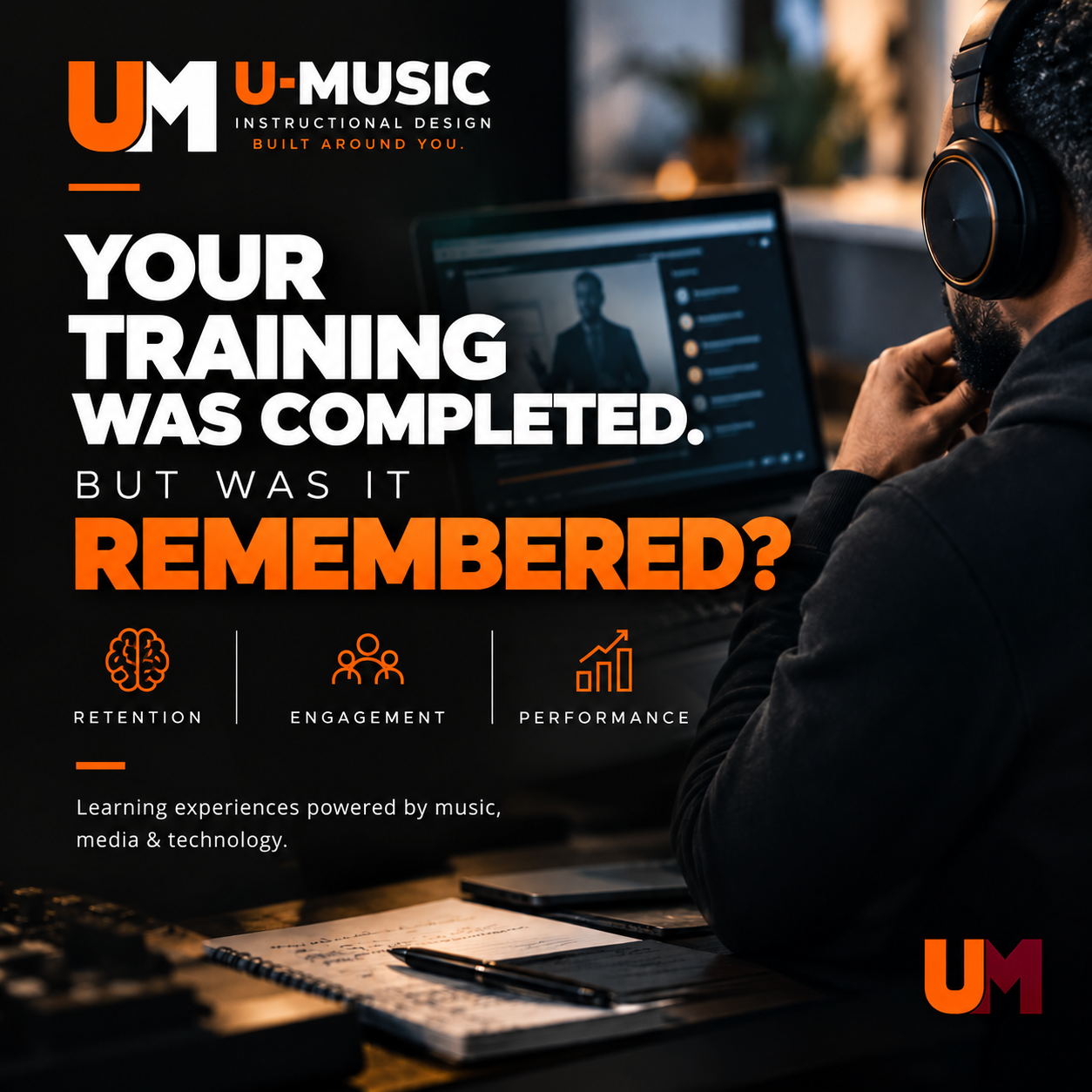
At U-Music, we focus on three outcomes through a framework called R.E.P.
Retention: Can people remember what they learned when they need it?
Engagement: Are people meaningfully involved in the learning experience?
Performance: Can people apply what they've learned in their actual environment?
I appreciate this framework because it moves the conversation beyond whether training was enjoyable or completed.
It asks whether the learning accomplished something meaningful.
And those questions aren't limited to corporate training.
They're relevant to educators, creative entrepreneurs, community organizations, music professionals, and anyone responsible for helping others grow.
Creatives Are Leaders. And Leaders Are Responsible for How They Communicate.
I've said for years that creatives are leaders.
We shape experiences. We influence understanding. We help people connect ideas, emotions, and actions.
But leadership also requires us to consider whether our message is actually reaching people.
That's where this opportunity connects to the larger body of work I'm building through The Artis Pro Lab and my own creative leadership philosophy.
It's not about making everything entertaining.
It's about being intentional.
Because creativity without purpose can become noise.
And information without understanding can become another completed assignment that changes very little.
So Here's My Question
Whether you're an employee, educator, business owner, HR professional, instructional designer, or organizational leader, I'd love to hear your perspective.
What's one training experience you completed but barely remember?
Or perhaps a training experience that genuinely helped you become better at something?
What made the difference?
I'm asking because I believe the people experiencing the learning deserve a voice in how we design it.
And because some of the most meaningful innovations begin when we stop assuming the existing approach is good enough.
The training was completed.
But was it remembered?
And more importantly, did it make a difference?
Keep creating. Keep leading.
Jastin Artis
Music Entrepreneur | A&R Leadership Architect | Strategic Growth Partner, U-Music
Creatives are leaders.